
Georgia City Directory Collections
Georgia’s historical directory shelf is a set of regional runs, not an annual statewide roll. University, public-library, archive, and digitization projects preserve different editions. Atlanta has the longest inspected sequence, while UGA lists nineteenth-century volumes from seven cities. The Digital Library of Georgia brings selected books from many communities online. Each collection entry identifies a route into the books; a blank year in one run does not mean that no resident record ever existed.
| Collection | Years or coverage | Where held | Access route |
|---|---|---|---|
| Atlanta city directories | 1859–1991, with gaps and combined editions | Fulton Library, DLG, UGA, Internet Archive | Special Collections, catalog, or digitized scans |
| Atlanta Haines criss-cross | 1946–2016/17 | Fulton County Library Special Collections | Address-level use through the collection |
| Georgia digitized directories | 214 volumes from 17 communities, nearly a century | Digital Library of Georgia and GPLS | Free online full text where digitized |
| UGA nineteenth-century set | About 70 volumes from seven cities | MAGIL; some older items at Hargrett | Catalog and researcher contact |
| Newspapers and family records | Collection and date range vary | Georgia Archives, DLG, FamilySearch probate records, local libraries | Search, browse, onsite, or indexed images |
For Atlanta, the city-directory series spans 1859–1860 through 1991, but it has missing editions and some combined years. Fulton’s separate Haines address run begins in 1946 and reaches 2016–2017. Statewide digitization is broad but selective; it is not an annual census of every Georgia town. Search the library catalog and collection guide before assuming a book is online or available for walk-in use.
Georgia Libraries and Directory Shelves
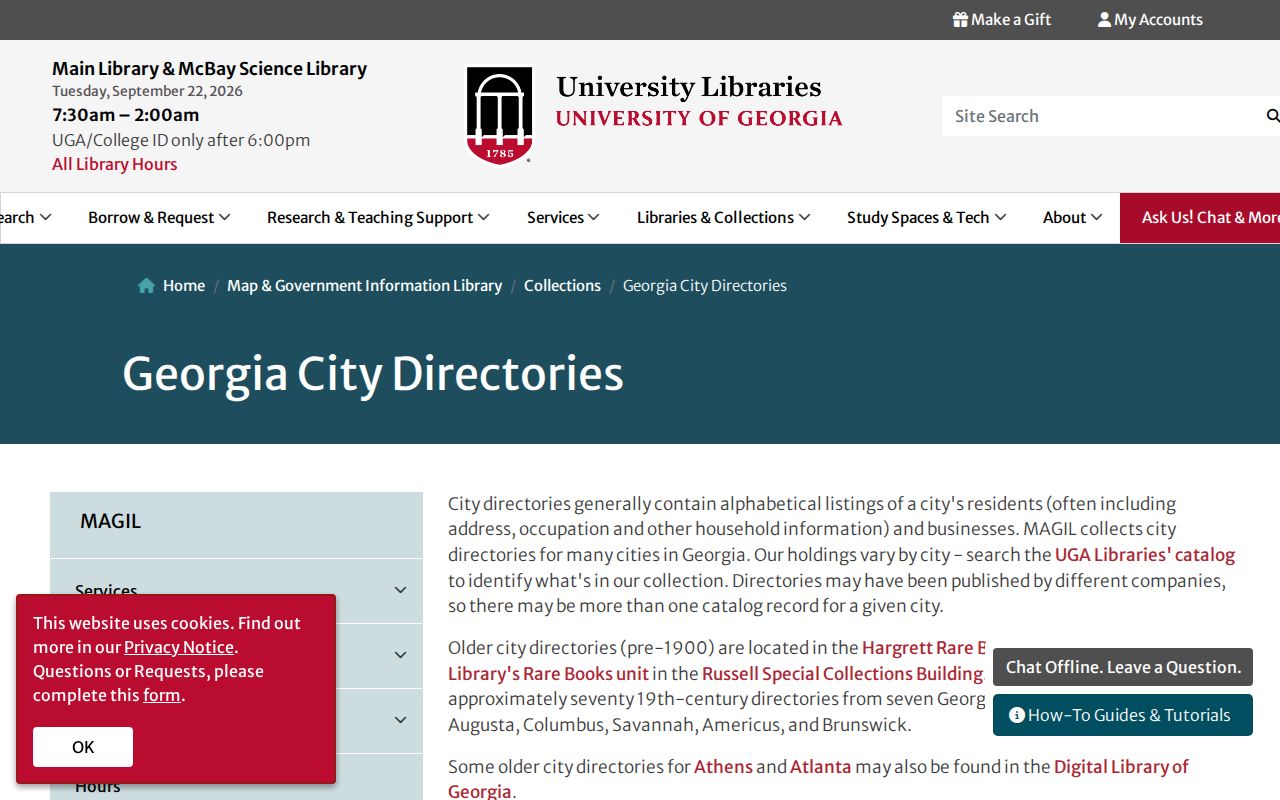
The UGA MAGIL city-directory collection lists about 70 nineteenth-century volumes for Athens, Atlanta, Augusta, Columbus, Savannah, Americus, and Brunswick. Pre-1900 books may instead be in the Hargrett Rare Book and Manuscript Library. The catalog and independent-researcher contact route help identify which room holds a needed edition. This matters when an online search returns nothing: a scan may not exist, and OCR can miss a name even when the page is on the shelf.
The UGA collection page shows its holdings, date ranges, and catalog path; consult the MAGIL directory holdings guide before planning a visit.
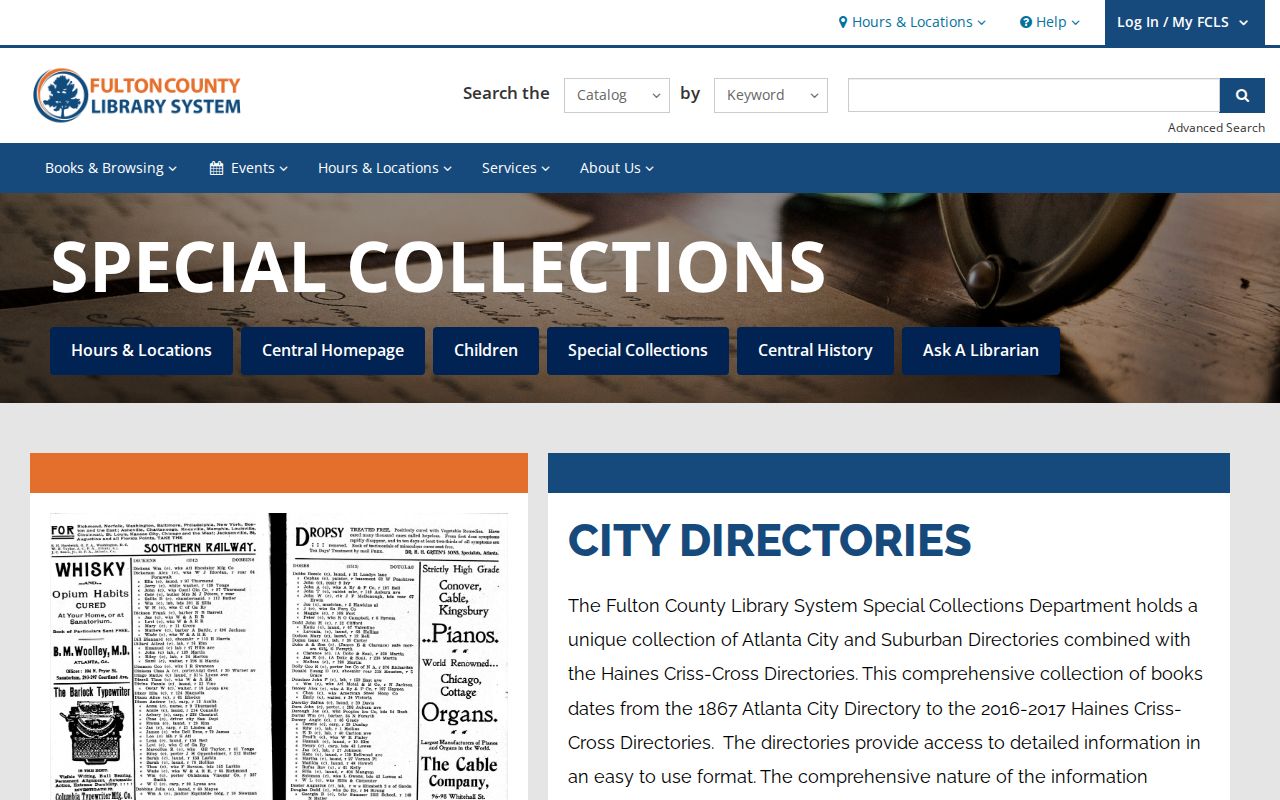
In metro Atlanta, Fulton County Library Special Collections holds the directory and reverse-directory guide, while UGA, DLG, and other partner collections offer alternate copies or formats. Access is not the same at each place. A catalog record may describe a volume without providing a full digital copy, and an independent researcher may need to contact staff about handling or search help.
Georgia Directory Publisher Runs
Atlanta’s changing imprint gives a practical way to find an edition. The 1859 book lists M. Lynch; V.T. Barnwell appears in 1867, A.E. Sholes in the late 1870s, and R.L. Polk from 1888 through 1892. Later imprints include H.G. Saunders in 1893–1896, Atlanta City Directory Co. in 1910–1985, and R.L. Polk again in 1986–1991. These are publisher credits, not proof that every year survives.
The Fulton collection guide places the runs side by side and notes the Haines address volumes. Its coverage panel is useful when a search needs a nearby edition rather than an exact year.
Combined editions include 1859–1860, 1951–1952, 1958–1959, 1978–1979, and 1984–1985. The OCR metadata also identifies missing years such as 1860–1866, 1868–1869, 1873, 1917, 1946, 1954, 1964, 1982, 1988, and 1990. A gap in one cataloged sequence is a cue to check another library or a related record, not to interpolate a household’s address.
Georgia Digital Directory Volumes
The Georgia Public Library Service digitization project reports 214 volumes from 17 communities through the Digital Library of Georgia. Examples include Albany 1922–1949, Athens 1889–1958, Atlanta 1867–1922, Columbus 1859–1912, Dalton and Griffin 1940–1963, and Macon 1860–1899. The years belong to individual runs, not to a statewide publication schedule. A text search can find a likely page, but the scan should be checked because older type and OCR can split or miss names.
The DLG item record for the 1891 Atlanta directory includes catalog metadata and a digitized volume with page images. The 1891 Atlanta City Directory record is a concrete example of what an online volume makes available.
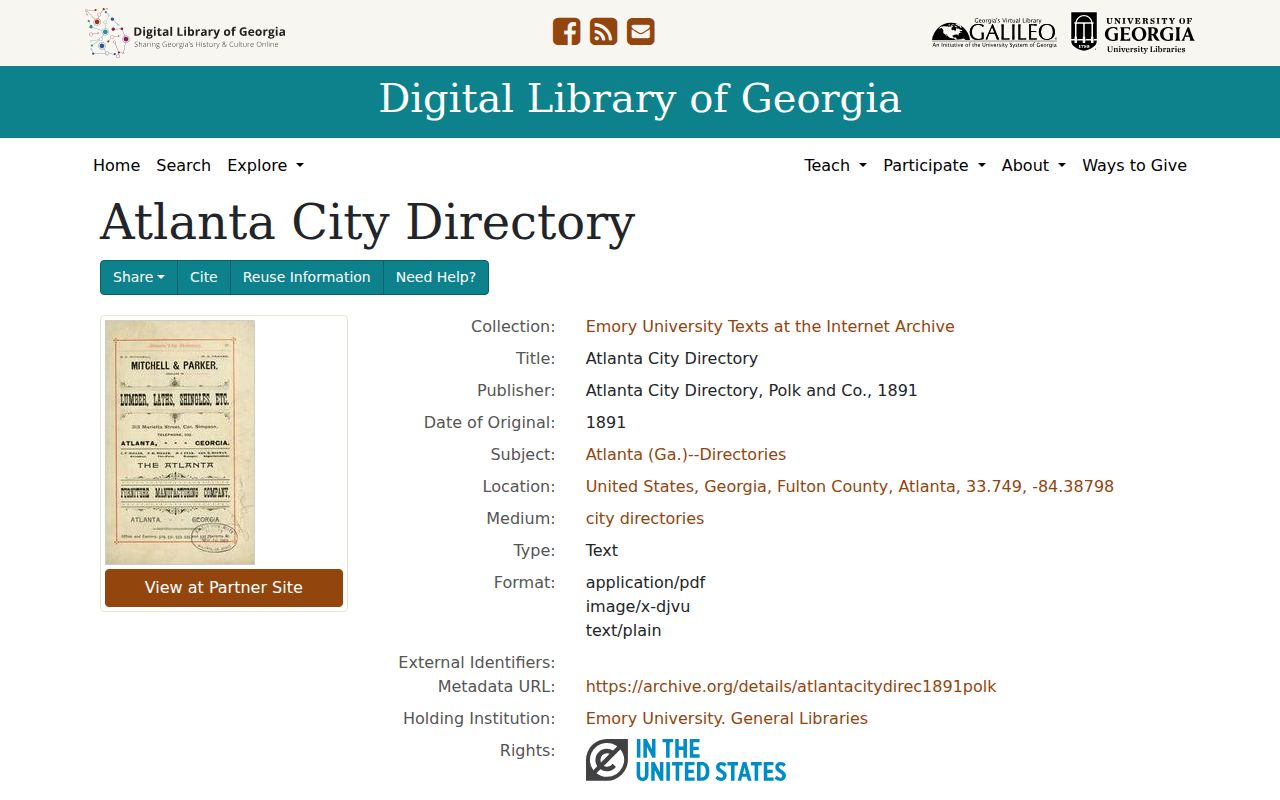
Open the page image as well as the search result, then note the printed page number and the edition label. If the digitized run does not cover a town or year, ask the local library, historical society, or Georgia Archives about its catalog, microfilm, or finding aid. DLG access is a valuable route, but it does not replace local holdings.
Georgia’s 1891 Directory Entry Marks
An 1891 Atlanta line shows why a directory entry needs to be read as a set of clues, not a modern residence statement. The Internet Archive OCR transcript of the digitized Atlanta volume transcribes “Abbett Charles E, elk C R R, bds 439 W Peters.” In the same volume, “r” marks a residence, “bds” means boards, and “wks” means works. A name may appear beside an occupation, a place of work, a telephone, a widow notation, or a death notice. The volume’s key and page image help resolve abbreviations the search text cannot explain.
| Printed element | How to read it |
|---|---|
| Name | Printed person or household name; verify spelling on the page image. |
| Occupation | A period label that may appear with a workplace or organization. |
| Address mark | “r” is residence; “bds” is boards; check the book’s own key. |
| Spouse or widow note | Use any printed relationship notation as a clue, then check another source. |
| Owner/renter mark | No universal mark is established here; use one only when that edition defines it. |
- Criss-cross directory
- A reverse directory arranged by street address so a reader can move from place to listed name.
- Householder index
- An alphabetical name index that points to a household entry in that edition.
- Abbreviation key
- The volume’s explanation of shortened words and symbols; check it before expanding a mark.
A directory line can blend a person’s name, association, and address. The same page can also note a boarder or a person whose name appears at a different location. “Bds” means boards, so do not convert it to a claim that the person owned or stayed at the house. Compare the same name in the next two available editions before inferring a move. Keep the original wording beside any modern paraphrase so later readers can see what the book actually printed.
Georgia City Directories by Address
An ordinary name directory usually takes a person’s name to an address. A criss-cross volume reverses that path and sorts by street, which can help with a house-history question when the name is unknown. Fulton’s Haines series covers 1946 through 2016–2017, while Atlanta’s city-directory collection reaches across a different set of years. Do not merge those series as if each year had the same format or fields.
For an address search, first confirm the historic street spelling and number. Check the directory’s street section or address index, then use the name entry to learn what else that edition prints. If an address changed, compare an adjacent year, a plat, or a Sanborn sheet before linking it to a current parcel. The Georgia Department of Community Affairs’ property-history guide notes that city directories may preserve streets, organizations, businesses, and city-limit context, but can omit rural households and people absent during compilation.
When a directory result leads to a current address question, the Georgia street directory page follows the modern parcel and deed chain. The historical entry remains evidence for its printed edition and place name.
Georgia Directory Editions Over Time
Publisher changes help explain why two nearby editions may look unlike each other. The Atlanta sequence moves from early local imprints to longer commercial runs, then to the separate Haines reverse-directory set. These are selected catalog milestones, not a claim that every annual volume survives.
| Period or edition | Publisher detail | Research use |
|---|---|---|
| 1859 | M. Lynch | Earliest listed Atlanta directory in the inspected sequence. |
| 1867; 1877–1886 | Barnwell; Sholes and Weatherbe imprints | Check each title page because imprints change across editions. |
| 1888–1892 | R.L. Polk | Includes the digitized 1891 sample entry. |
| 1910–1985 | Atlanta City Directory Co. | Long run with missing and combined-year editions. |
| 1986–1991; 1946–2016/17 | R.L. Polk; Haines reverse directories | Separate name-first and address-first sequences. |
Some known combined editions cover 1859–1860, 1951–1952, 1958–1959, 1978–1979, and 1984–1985. The catalog also identifies several gaps, including 1917, 1946, 1954, 1964, 1982, 1988, and 1990. Treat a gap as a limit of that run; the next step may be a newspaper, deed, census, or library finding aid rather than an assumed year-to-year move.
Tracing Georgia City Directories Across Generations
To follow a household, use each book as a dated point on a timeline. Georgia directories can bridge names and street addresses between census years, but they are not a complete count of everyone in a town. The Atlanta volumes have publisher and edition gaps, so choose the nearest available years and note the gap instead of treating the sequence as continuous. Keep the edition title, publication year, page, and exact spelling with each entry.
- Find the name in the closest available edition and copy the entry as printed, including address marks and any relationship note.
- Check the prior and next available volume for a spelling change, street move, or different household notation.
- Use a criss-cross section to search the address when the name is unclear or the question starts with a house.
- Pair directory years with the decennial census and compare the address, household members, and dates without assuming the records share a coverage date.
- Use a newspaper, obituary index, cemetery source, deed, or probate file to test a family-history lead.
If a person disappears from the next volume, the book alone cannot show whether they moved, died, were missed, or fell outside the compiler’s scope. The Georgia Archives research room offers finding aids, the Virtual Vault, newspapers, name files, and onsite resources; FamilySearch Georgia probate records may add estate or family links. A directory entry records a name in an edition year; a current assessor card reports a tax-roll owner, and a deed records a conveyance. None bridges every year by itself. Compare dates and record roles before joining a directory name to a living person. When a lookup seeks one person’s current record, use the Georgia resident lookup page for the separate official-source path.