
Georgia Previous Residents by Era
The trail for previous residents in Georgia changes with the date and the type of evidence sought. A deed names parties to a transfer; a criss-cross directory may connect a name to an address; a Sanborn sheet maps a building or lot. None is a complete list of people who occupied one home. Use the table as a route map, then check a record’s county, year and access terms before treating the result as part of one household history.
| Source | Known Date Range | Where to Find It | Evidence It Adds |
|---|---|---|---|
| GSCCCA deed index | Statewide floor generally January 1, 1999; older county depth varies | GSCCCA and county Clerks of Superior Court | Recorded parties, instrument and property trail |
| Atlanta Haines criss-cross | 1946 through 2016–2017 | Fulton County Library Special Collections | Address-to-name lookup by edition |
| Atlanta city directories | 1859–1991, with missing and combined editions | Fulton, DLG, UGA, Emory and Internet Archive | Dated name, address and occupation listing |
| Georgia Sanborn maps | UGA holdings 1880–1985; selected DLG maps 1884–1925 and 1926–1941 | UGA MAGIL, DLG and Library of Congress | Footprint, use and lot context |
| Georgia probate records | FamilySearch collection spans 1742–1990; county holdings vary | FamilySearch, county Probate Court and Archives | Estate, heirs, property and family links |
| State death records | Statewide registration began in 1919 | DPH, Georgia Archives and FamilySearch | Life event and family details, subject to access rules |
For a recent property transfer, begin with the current parcel card and recorded deed. For an older address, a printed directory or Sanborn map may survive where an online parcel index does not. Georgia’s statewide deed layer has a modern floor, but local deed books, courthouse terminals, microfilm, libraries and Archives holdings can extend the search. A record not found online should lead to a documented fallback, not an assumption that no record exists.
Georgia Deed Records and County Books
The GSCCCA Consolidated Georgia Real Estate Index brings county deed, lien and plat records into a statewide discovery layer. It supports county, regional or statewide searches, with fields that can include grantor, grantee, party type, instrument, date, book and page, property location and geographic filters. Some records allow a street address, subdivision, unit, block, lot, map or sale-price search. Address fields may be missing or indexed in an unexpected form, so the legal description and parcel are often better anchors for older work.
The statewide deed-index horizon generally begins January 1, 1999. Older records and images are being added through separate county projects, and the depth differs across Georgia. Online account levels and printing charges change; the inspected GSCCCA page listed paid monthly tiers and a per-page print charge as of July 1, 2025. Check current terms before ordering. Public-search terminals at the county Clerk of Superior Court remain useful for earlier deeds, and the clerk is the custodian for missing images and certified copies. Georgia’s Consumer Protection Division warns about deed-copy mailers that charge for a routine record; compare a notice with the official clerk route.
A deed index identifies a record to retrieve. It does not say who slept in the home or whether a named person remained there after the transfer. Read the deed image before stating what interest changed, and use a tax card only as a lead to the parcel and owner field.
Trace Georgia Previous Residents Through Deeds
A deed chain follows a property instrument from the current tax-roll name to an earlier conveyance. In Georgia, use the county assessor portal reached through the Department of Revenue property-records directory to note the parcel ID, situs address, mailing address, legal description and subdivision or lot. Then search GSCCCA for the latest purchase deed. Move backward by using the earlier grantee as a name search and checking the legal description against the parcel.
Work through the chain one instrument at a time. If the transfer names a trust, estate, lender or company, follow that record’s role instead of treating the party as a household member. This property-first route can help when a surname is common: compare each party with a directory entry for the same year and street instead of relying on a name alone. Georgia recording date and execution date can differ, and the address may be absent or changed. A dated deed image is stronger evidence of a conveyance than a portal summary.
- Find the parcel and write down its ID, legal description, current tax-roll owner and situs address.
- Search the county deed index by that owner or parcel, then open the latest purchase instrument.
- Record the buyer, seller, instrument number or book/page, recording date and legal description.
- Search the prior grantee as a new party and confirm the same land description before moving back again.
- For years outside online coverage, ask the county Clerk of Superior Court about deed books, microfilm or terminal access.
- Grantor / grantee
- The grantor transfers an interest; the grantee receives it.
- Chain of title
- The sequence of recorded conveyances tied to a parcel.
- Legal description
- The land description in the deed; it can identify a lot when a street name or number changed.
Georgia Directory Records by Year
Deeds follow recorded property interests, while address-keyed directories can surface people listed at a Georgia address. Fulton County Library Special Collections holds Atlanta city directories from the nineteenth century through 1991 and Haines criss-cross volumes from 1946 through 2016–2017. The regular city directory is mainly name-to-address; the reverse volume can be searched from the address to a name. A missing entry may reflect an edition gap, city limits, compilation timing, spelling or a household the publisher did not list.
For each result, record the edition and whether it is an ordinary name-to-address directory or a reverse address-to-name volume. Outside Atlanta, Georgia collections are held by UGA MAGIL, Hargrett, DLG, local libraries and historical organizations; annual runs are not complete in every community.
Because the collections themselves have their own catalog, publisher and reading details, the Georgia city directory collections page covers that shelf in depth. Here, use a volume as one dated address clue within a wider property history.
Map Georgia Previous Residents on Sanborn Sheets
Sanborn fire-insurance maps can bridge a printed street address to a parcel shape. Georgia maps may show a building footprint, use, construction, stories, outbuildings, street width and lot context. They can help test whether a directory address referred to a home, boarding house, shop, church, school or other structure. A map’s date is not an occupancy date, and it does not identify the people inside a building.
The UGA MAGIL Sanborn guide lists Georgia print and microfilm holdings, as well as selected digitized materials. Start from the city, year and sheet, then compare its address or lot with a directory, plat or deed rather than lining up a modern map by eye.
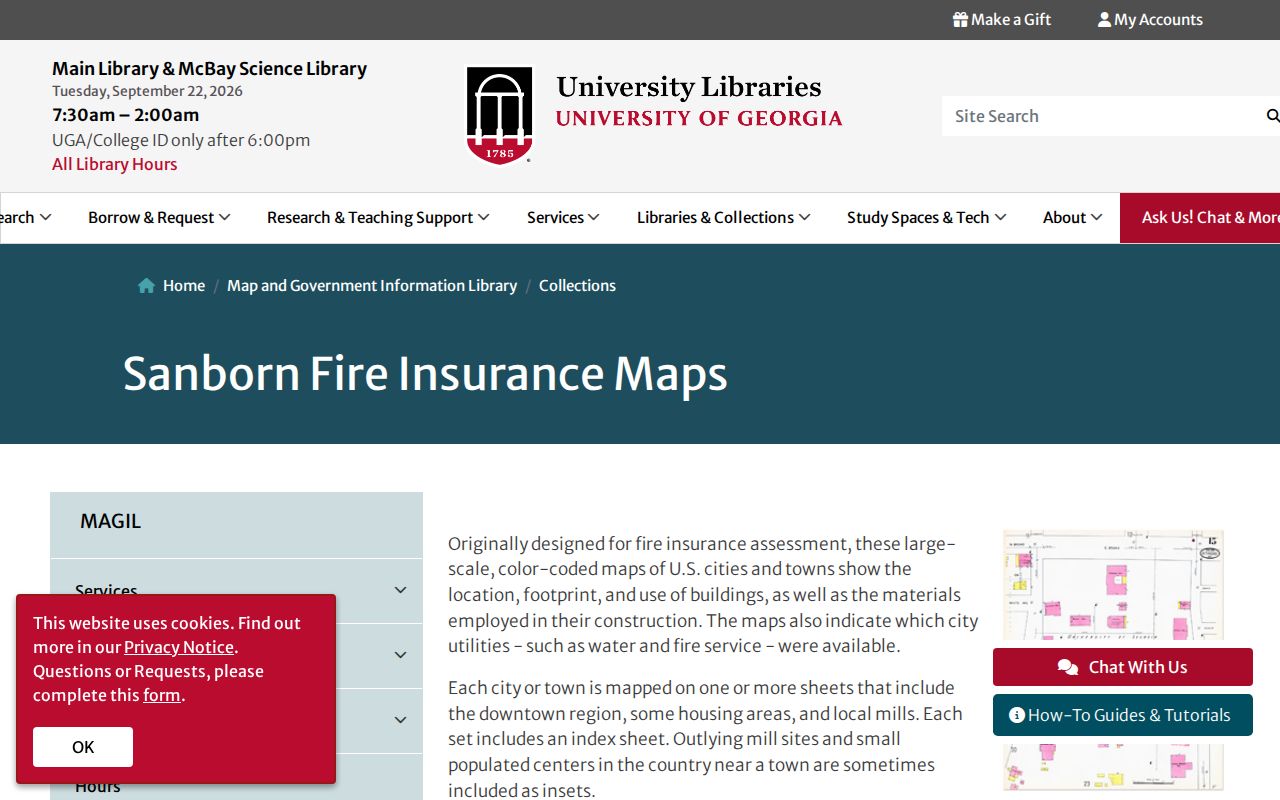
The catalog view helps identify the right map sheet and year before it is used to support a house-history claim.
For Atlanta, the Library of Congress digitized a seven-sheet 1895 set. UGA’s broader guide describes holdings from 1880–1985, selected DLG maps from 1884–1925, and selected later material through 1941. Coverage is mostly urban, so a rural Georgia address may need county maps, deed plats, directories or archive help instead.
Trace Georgia Past Households Through Census Records
Previous residents of a Georgia property can appear in sources that answer different questions. A directory records a compiler’s dated listing; a census gives a household snapshot; an obituary or probate file may add kinship or an estate link. Pair records by address, date, household role and name variant, but do not assume that the same street number refers to the same lot across every edition. The Georgia city-directory collections page explains each publisher and catalog; those volumes serve here as evidence in an address timeline. An 1891 Atlanta entry uses “bds” for boards and “r” for residence, so compare the next editions before calling either mark a stable household.
For each available period, compare the nearest directory and census entries, then look for a second record that supports the connection. The Georgia city directory collections page identifies the holdings and access routes for those historical volumes.
- Write the directory’s year, printed street name and number, household notation and spelling exactly as shown.
- Check a census entry from the closest available enumeration year for the same street, household head and family roles.
- Use a deed, probate file, newspaper notice or map to test whether the address and person still align.
- Mark missing years and uncertain matches instead of filling gaps with an assumed continuous residence.
For relatives, the Georgia Probate Records collection spans 1742–1990, with fields that can include testators, heirs, witnesses, residence, property and document dates. Local Probate Courts and Archives may hold records beyond the images or indexes available online. Obituary indexes, cemetery records and newspapers can help close a family trail, though a death event does not establish how long someone lived at a prior address.
House-history use. Keep previous-resident research focused on a property’s documented past or your own family history. Do not use an address trail to track, harass or expose a living person.
Georgia Vital Records and Archive Limits
Georgia began statewide birth and death registration in 1919, so earlier life events often require county, church, newspaper or family sources. The Georgia Archives notes that death certificates from 1919–1943 are indexed through FamilySearch and that originals through 1943 are held at the Archives; pre-1919 coverage is sparse. Current DPH birth and death copies have relationship or tangible-interest rules, while older records become public under the state’s time thresholds. For marriages, Probate Courts hold records under the state’s long county history, but survival differs where a courthouse disaster affected a series.
The Georgia Archives vital-record guide describes registration history, county material and the limits of statewide indexes.
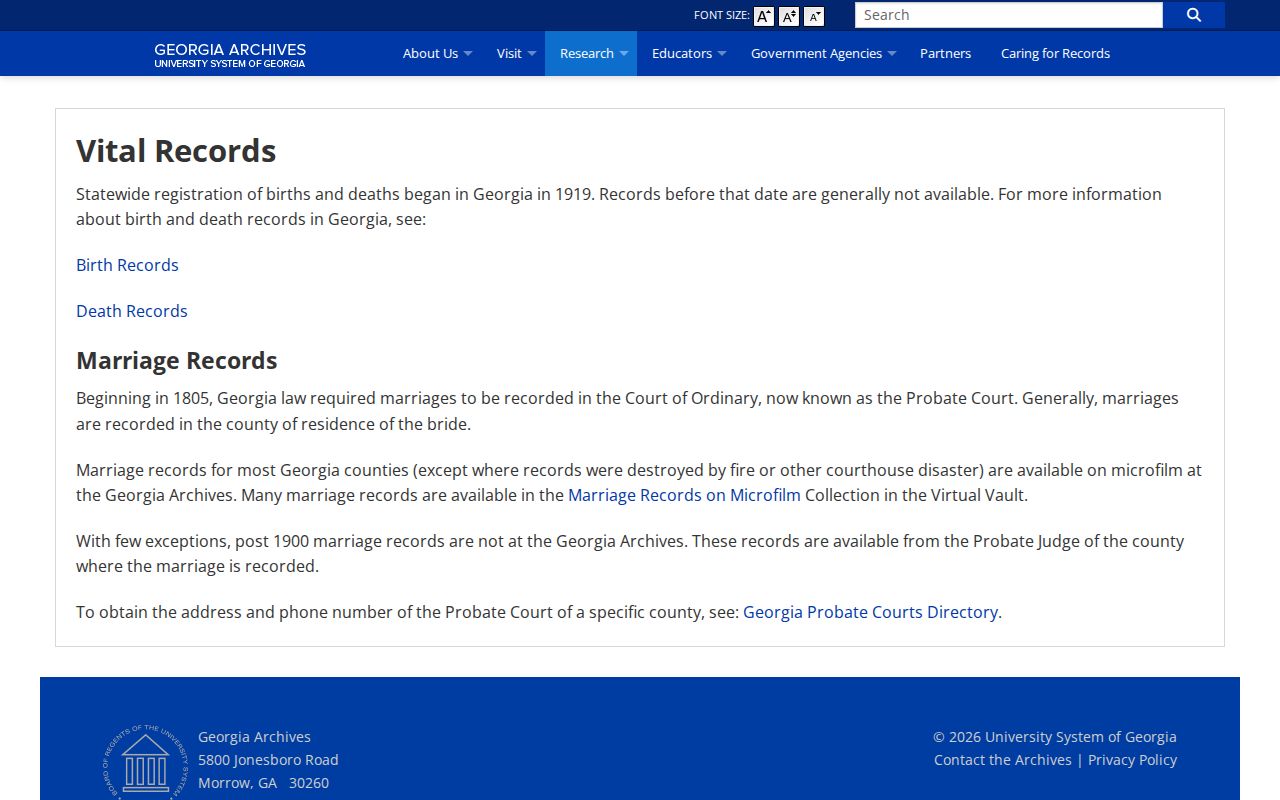
Use the guide to choose a state or county custodian, then verify the current eligibility and request route before seeking a certificate.
The Archives holds statewide marriage and divorce indexes only for selected periods, not one continuous index for every year. A certificate or probate record may contain private details, and access depends on the record type and applicant. Treat these sources as family-history endpoints rather than a general list of current Georgia residents.
Audit a Missing Georgia Address Record
An old Georgia street number may not match today’s parcel text. Atlanta’s documented street changes include McDonough to Capitol, Grubb to Poplar, and Magazine to Magnolia. City grids, directionals, suffixes, annexations and local renumbering can all interrupt a plain text search. For a vanished address, compare the current parcel geometry, a historic directory entry, a Sanborn sheet and a deed or plat. The deed or plat should confirm the lot; map alignment by sight is only a lead.
A missing online result also calls for a coverage check. Ask whether the event predates GSCCCA’s statewide index floor, the county differed at the event date, an entity or estate appears in place of a family name, the image is only at a clerk terminal, a disaster affected a specific series, or OCR changed the spelling. Georgia Archives digitization continues, so revisit DLG, the Virtual Vault and archive finding aids after a meaningful update. State what was searched, when, and where a record was not located, instead of saying it does not exist.
Keep address types distinct in a timeline: tax situs, tax mailing, deed legal description, directory address as printed, postal city and legal municipality. A modern assessor can identify a current tax-roll owner; a historical directory can list a name in a past edition; a recorded deed can show a transfer. No one row joins those dates by itself. When earlier deeds are missing online, ask the county Clerk of Superior Court about local books, microfilm and terminal access, then consult the Georgia Archives or a local library.