
Start a Georgia Resident Search
Pick a record that fits the question before you type a name. A property card can tie an owner to a parcel, but it does not name every person in the home. A voter record has a different purpose, and a historical directory is a dated listing rather than a live roll. Georgia's resident records sit with state offices, county custodians, courts, cities, libraries, and archives. The most useful first step is to note what is known: a county, a street, a parcel, a case, or a year. That small choice helps avoid mixing records that describe different people or different kinds of addresses.
Keep a short log as the search moves from one custodian to another. Record the source, date, terms, county, and the type of address shown. Preserve the source's own field labels rather than treat every address as a current home. If the first search has no result, the source may lack that year, use another county's records, or hide a protected field. A negative result is a prompt to check coverage, not proof that a person or record does not exist.
- Use the Georgia Department of Revenue directory to select the county tied to the address or event.
- Choose the matching official source: assessor, voter self-service, court, vital-record office, or archive.
- Save a stable key such as a parcel, instrument, case, or event number when the result provides one.
- Check a second source with a different purpose, then ask its custodian for an image or certified copy if needed.
- If no web index covers the record, try the clerk, registrar, library, or a narrow Georgia Open Records request.
Georgia's State and County Custodians
Georgia has 159 counties, and no one office holds a complete statewide list of residents. County Boards of Tax Assessors value property; Tax Commissioners collect the tax. Clerks of Superior Court keep deed, lien, plat, and court records. Probate Courts hold many marriage and estate records, while county registrars maintain local election files. State portals help a reader find the right route, but the county or agency named on the record remains the custodian.
These four state-level starting points cover common paths into the local layer. A Georgia resident search may still require a county portal, a local clerk, or an archive visit when the statewide page only links outward.
County Property Offices
The Department of Revenue links to local tax offices and assessor systems.
Georgia's Department of Revenue links to county property portals.
Superior Court Clerks
Local clerks hold land records; GSCCCA supplies a statewide index layer.
GSCCCA joins local deed indexes in a statewide search layer.
Secretary of State
Election services, business filings, and public license tools sit with this office.
The Secretary of State provides voter self-service and election records.
Public Health Vital Records
DPH and local registrars handle birth and death records under access rules.
Current Georgia Resident Records
Several record systems contain names linked to property, registration, court events, or public filings. None is a statewide census of households. A tax roll is strongest for a parcel and its owner field; My Voter Page is for a voter checking their own status and polling details. A court docket is tied to a case. Treat each result according to its office and record date.
| Record source | What the entry describes | Custodian or route | Access limit |
|---|---|---|---|
| Assessor tax card | Parcel, tax-roll owner, situs and mailing fields | County portal reached through DOR | County fields vary; not proof of occupancy |
| Voter status | Registration status, polling place, district information | Georgia My Voter Page | Protected addresses may be hidden |
| Deed index | Parties and recorded land instruments | GSCCCA and county clerk | Older county coverage varies |
| Court docket | Case parties, dates, status, and visible filings | Participating county portal or clerk | No single index covers every court |
| Historical directory | A person's listing in a named edition | Library, DLG, UGA, or archive | Year, city limits, and omissions matter |
For a one-person task, compare name spelling, county, year, and a stable record number before joining entries from separate systems. Keep each result tied to its purpose. City employee pages, neighborhood groups, and business filings are not general resident rolls, and a posted civic contact list should never be treated as a private membership roster.
Georgia County Property Search
The Georgia DOR property-record directory is a county selector, not a single parcel database. Choose the county, then use its linked assessor or GIS portal. Many county systems accept an owner name, address, or parcel ID, but search labels and card fields differ. Tax assessors set property values; Tax Commissioners collect ad valorem tax. A tax card can show a situs address, a separate tax-mailing address, parcel details, exemptions, and assessed values. It cannot establish who currently sleeps in a building or who holds every legal interest.
The state directory's county list and ownership warning are visible in the official property-records page. The capture below shows the handoff from a state page to local systems. Use it to choose a county, then check the destination portal's own help text before searching.
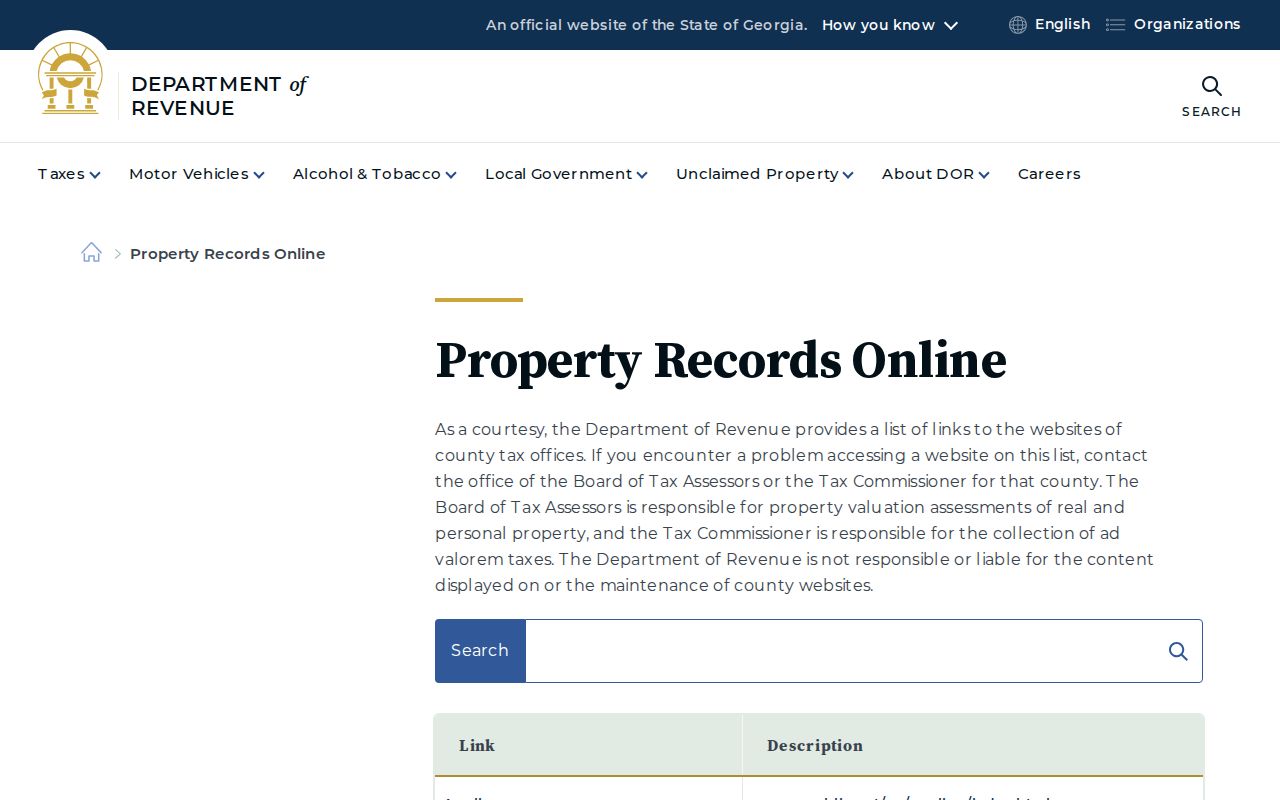
This county-by-county path matters because owner-name behavior, update dates, and map layers are set locally. That distinction keeps a residents directory search from treating a property owner as every person at a Georgia address. When the aim is to follow parcels down a named road, use the Georgia by-street workflow and keep tax owner, mailing address, and occupant as separate facts.
| Property search field | How it is used |
|---|---|
| County | Select a county in DOR, then open its linked system. |
| Owner name | Text search; exact or partial behavior depends on the county. |
| Street address | Text field in many local portals; spelling and unit format can affect results. |
| Parcel or alternate ID | Use the county's displayed identifier for a direct card match. |
| Map or geometry | Some GIS systems let a user select a parcel or query a map. |
| ZIP, subdivision, or tax district | Optional local filters; these are not present in every county system. |
Georgia Deeds and Land Indexes
The GSCCCA Consolidated Georgia Real Estate Index brings county deed, lien, and plat indexes into a statewide search layer. Search options include county, region, or state scope and, where supported, grantor or grantee, property location, instrument type, date, book and page, subdivision, block, lot, or address. A grantor is a party conveying an interest; a grantee receives one. Neither role alone says who lived at a property.
The online deed index generally reaches back to January 1, 1999 statewide, but older records and images vary by county. GSCCCA describes limited/free and paid account options; its July 2025 comparison listed regular and premium subscriptions and a per-page print charge. Prices change, so review the account page before use. Courthouse terminals are another route during the clerk's regular business hours. The county Clerk of Superior Court remains the custodian for local books, plats, missing images, and certified copies.
A useful land trail begins with a parcel ID or legal description, then moves to the latest recorded instrument and its book/page or instrument number. If an image is absent, ask the clerk for that exact reference. This brief overview identifies the statewide path; the address-by-address mechanics belong with the page about streets and parcel records.
- Parcel
- A county's mapped tax unit for a piece of land.
- Situs address
- The physical location assigned to a property record.
- Tax-mailing address
- The place where tax notices are sent, which may be elsewhere.
- Index
- A searchable pointer to a record; read the recorded image for its terms.
Georgia Voter Status and Public Files
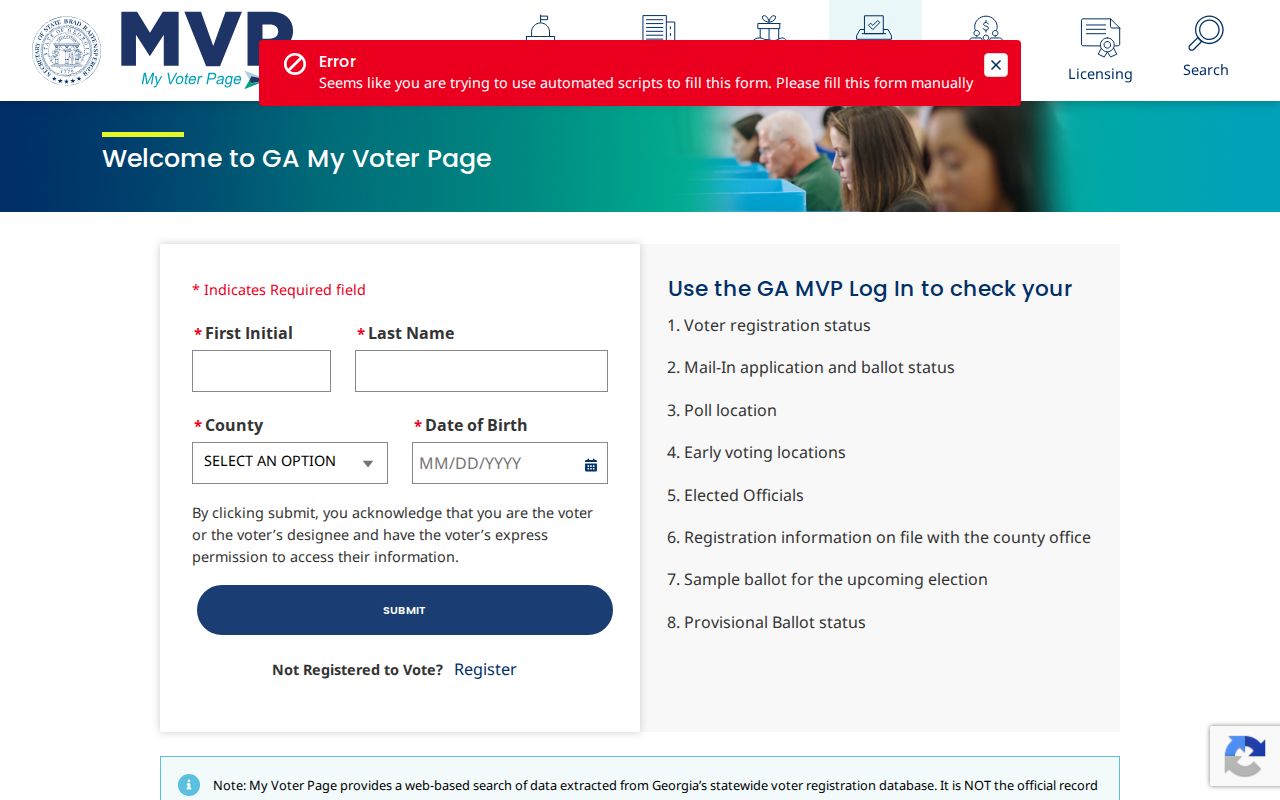
The Georgia My Voter Page lets a voter check registration status, polling place, sample ballot, and elected officials. Its live form is dynamic, so identity prompts can change. The public self-service page is useful for an individual verifying their own details; it is not a guarantee of current physical residence. A protected voter may not appear in the ordinary way.
For a wider official file, the Secretary of State accepts orders for Georgia voter-registration lists. The order page describes jurisdiction choices, fields, fees, electronic delivery, and a processing period generally around two weeks. It restricts the file to voter-registration use. Public columns can include name, birth year, registration status, residence and mailing fields, precincts, districts, registration dates, and voting history. Full birth date, Social Security number, driver's-license number, and telephone number are not included. Georgia does not register voters by party, so a “last party voted” field is election history rather than party enrollment.
The captured My Voter Page form can change its labels as the state updates the service. Follow the current prompts rather than relying on a fixed field list.
For county office contacts and local procedures, use the Georgia registrar locator. Statewide access does not remove privacy limits: VoteSafe and Safe at Home can seal or substitute residence information for qualifying people. Do not try to infer a protected address from a nearby field or another record.
Georgia Court Records by County
Georgia Courts eAccess points to participating county State and Superior Court portals. It is a gateway, not a complete statewide index. Georgia also has Municipal, Magistrate, Probate, Juvenile, and federal courts, and their systems and public access differ. A representative portal can search by party or case name, case number, business, attorney, court, category, filing dates, and status. Results may show the case style, parties and roles, docket events, hearings, disposition, and documents.
Provider accounts, search depth, required fields, and document charges vary. A free index view may lead to a paid image or a clerk's public terminal. If a result matters, use the case number to ask the proper clerk for the complete file or a certified copy. Sealed, juvenile, adoption, and protected family cases do not display as ordinary public records. A party entry or an address filed in a case is not proof that the person lives there now.
For a legal question, report what the docket says and when it was checked. Do not merge a court hit with an assessor, voter, or business result based on a common name alone. Georgia has no one public court search that covers every county, case type, and year.
Georgia Birth, Death, and Marriage Records
The Georgia Department of Public Health and county registrars handle birth and death records. Birth and death certificates are restricted during the confidential period, and an applicant may need a valid photo ID plus proof of a qualifying relationship or direct and tangible interest. DPH lists records from 1919 forward. Under the cited state framework, records generally open after 100 years from birth or 75 years from death, but the method still depends on record type and custodian.
The state request page lists one certified birth or death copy at $25, an extra copy at $5, and a marriage copy at $10. Online, mail, and office routes are described, but current fees and processing options should be checked before ordering. DPH holds marriage records from June 1952 through August 1996. For earlier or later marriages, contact the Probate Court in the county where the event occurred. DPH can confirm some divorces from that period; the Superior Court clerk holds the case copy.
The Georgia Archives vital-records guide notes that marriage recording through Probate Court reaches back to 1805, though courthouse losses and county survival affect what remains. The Archives has indexes for selected periods, not one complete statewide index for every year. Vital records can support family history and identity work, but they are not an open list of living residents.
Historical Georgia Resident Directories
Georgia's historical directories are held by libraries, archives, and digitization projects rather than by one statewide publisher. UGA MAGIL reports about 70 nineteenth-century volumes for Athens, Atlanta, Augusta, Columbus, Savannah, Americus, and Brunswick. Georgia Public Library Service and the Digital Library of Georgia report 214 digitized directories from 17 communities. Fulton County Library's Atlanta holdings run from the nineteenth century through 1991, with Haines reverse directories from 1946 through 2016–2017.
The collections have gaps, combined-year editions, changing publishers, and OCR errors. The Digital Library's 1891 Atlanta volume lets a reader compare the scanned page with its text record. The digitized Atlanta directory item is one example, not a complete statewide run. A standard directory often moves from a name to an address; a criss-cross volume starts with an address and may identify a listed household. Either describes a dated compilation, not continuous occupancy.
Use the Georgia city directory collections page for collection-by-collection years, access routes, and entry-reading tips. The old volumes add a past-time layer to a Georgia residents directory search when the edition and city limits are clear. For a current address, compare historical listings with a modern parcel record and note the gap rather than treating the old entry as a live result.
Georgia Custody and Registry Searches
The Georgia Department of Corrections offender search supports queries by name, description, GDC ID, or case number. It does not cover every county jail, federal facility, or historical detention record. For a local jail, contact the sheriff in the county that holds the record. GDC cautions users to verify a result in writing.
The GBI sex-offender registry is a separate public-safety system under state law. Public information can include a registered person's name, birth year, address, registration details, and a photograph; administrative fields remain protected. The registry updates as local sheriffs report residence information. Check the status and date shown on the official record, and do not treat it as a general criminal-history search or as proof of a person's present location.
Georgia Business and License Records
The Secretary of State's business search has Starts With, Contains, and Exact Match modes for a company name. It also accepts a control number, registered-agent name, or officer name. A result can show entity status and filing roles. A registered office is a business contact point, not a person's home. Assumed-name filings generally sit with the county Clerk of Superior Court, and the research did not find one statewide DBA index.
Georgia's professional-license verification portal lets a user choose a profession and license type, then search by a first, middle, or last name or license number. Some fields support a wildcard, but boards differ in what they show and how far their history goes. Keep the license type, result date, and board with the search note. A name hit identifies a public credential record; it does not establish a current residence or every role a person holds.
Georgia Record Requests and Gaps
When a record is not online, first identify the office that created or keeps it. The Georgia Open Records Act, O.C.G.A. §§50-18-70 et seq., generally requires an agency to provide existing records within three business days or explain timing, expected cost, or an exemption. It does not require staff to create a new report. Ask for a narrow item such as a parcel card, permit, instrument, or case file, and use the office's preferred form where one exists.
Do not send a broad request when a county clerk can retrieve a deed from a book/page reference or a library can check a directory volume. If a request costs money, ask for an estimate before the search grows. Search, retrieval, redaction, and copies can carry charges under current rules. When an old item is missing, check the county's older books, courthouse microfilm, the Georgia Archives, FamilySearch, and a local library before deciding that it was never kept.
Scams often copy the look of an official deed or records notice. The Georgia Consumer Protection Division deed-copy guidance advises readers to compare a demand with the county clerk and the GSCCCA route. Keep a dated record of the exact source and query, and report a failed lookup as “not located in this source as of this date.”
Personal use. Use Georgia public records for a lawful, specific purpose. Do not use names or addresses to stalk, harass, threaten, or expose a protected person.
Georgia Addresses and ZIP Geography
A Georgia postal city, legal municipality, county, ZIP code, and tax district can point to different boundaries. A Metro Atlanta mailing label may not match the city or county that handles a parcel; coastal and historic places may keep older street names in books after a local change. Store each value as the source printed it. Match a historical address to a current parcel with a plat, map, directory, or municipal record rather than by city name alone.
USPS lookup checks delivery format and postal naming. It does not confirm that a person is at a street address. The Census Bureau's ZIP Code Tabulation Areas are statistical approximations, not USPS ZIP codes and not municipal borders. Some assessor portals accept a ZIP filter, some show ZIP only on the card, and some need an address or parcel. No statewide property portal gives one reliable ZIP-wide list for all Georgia counties.
For a single place, keep the tax situs, tax-mailing address, postal city, legal municipality, county, parcel, and ZIP as separate fields. That small habit makes a Georgia resident directory search easier to check and keeps records from appearing to disagree when they answer different questions.